
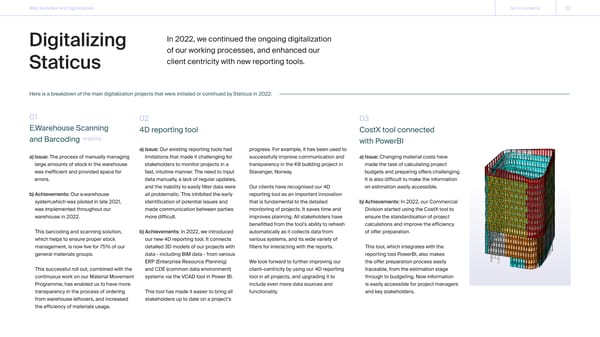
R&D Activities and Digitalization Go to contents 32 Digitalizing Staticus In 2022, we continued the ongoing digitalization of our working processes, and enhanced our client centricity with new reporting tools. 01 E.Warehouse Scanning and Barcoding a) Issue: The process of manually managing large amounts of stock in the warehouse was inefficient and provided space for errors. b) Achievements: Our e.warehouse system,which was piloted in late 2021, was implemented throughout our warehouse in 2022. This barcoding and scanning solution, which helps to ensure proper stock management, is now live for 75% of our general materials groups. This successful roll out, combined with the continuous work on our Material Movement Programme, has enabled us to have more transparency in the process of ordering from warehouse leftovers, and increased the efficiency of materials usage. ongoing 03 CostX tool connected with PowerBI a) Issue: Changing material costs have made the task of calculating project budgets and preparing offers challenging. It is also difficult to make the information on estimation easily accessible. b) Achievements: In 2022, our Commercial Division started using the CostX tool to ensure the standardisation of project calculations and improve the efficiency of offer preparation. This tool, which integrates with the reporting tool PowerBI, also makes the offer preparation process easily traceable, from the estimation stage through to budgeting. Now information is easily accessible for project managers and key stakeholders. 02 4D reporting tool a) Issue: Our existing reporting tools had limitations that made it challenging for stakeholders to monitor projects in a fast, intuitive manner. The need to input data manually, a lack of regular updates, and the inability to easily filter data were all problematic. This inhibited the early identification of potential issues and made communication between parties more difficult. b) Achievements: In 2022, we introduced our new 4D reporting tool. It connects detailed 3D models of our projects with data - including BIM data - from various ERP (Enterprise Resource Planning) and CDE (common data environment) systems via the VCAD tool in Power BI. This tool has made it easier to bring all stakeholders up to date on a project’s progress. For example, it has been used to successfully improve communication and transparency in the K8 building project in Stavanger, Norway. Our clients have recognised our 4D reporting tool as an important innovation that is fundamental to the detailed monitoring of projects. It saves time and improves planning. All stakeholders have benefitted from the tool’s ability to refresh automatically as it collects data from various systems, and its wide variety of filters for interacting with the reports. We look forward to further improving our client-centricity by using our 4D reporting tool in all projects, and upgrading it to include even more data sources and functionality. Here is a breakdown of the main digitalization projects that were initiated or continued by Staticus in 2022:
 Staticus Capability Statement Page 31 Page 33